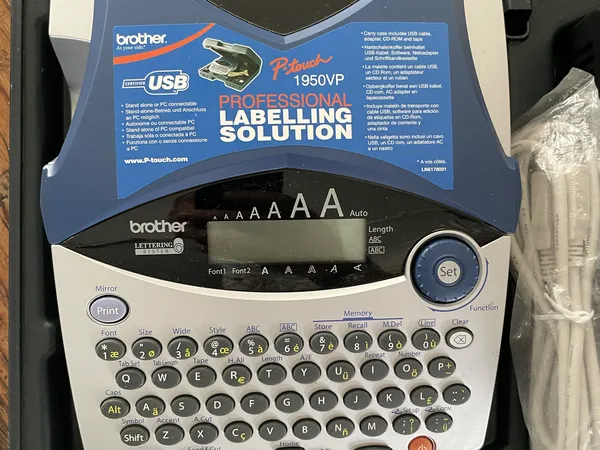
The PT-1950 came in a case. It had a large keyboard, a small display, narrow smooth labels and a USB port on the side. Even the old booklet and CD were still there. Without a computer, the keyboard offered a few fonts, upper- and lowercase and a line. That is still useful when working away from a desk.
Koert connected it to see what LumenLabel could do. The app immediately detected a USB device, but not yet a supported printer. After three or four hours of investigating, nothing had come out and the cutter still did nothing. The case was closed again.
Later, he tried once more. That was when the cut code and the rules for the cut marks became clear. A white section came first, followed by the marks, the text and another set of marks. Then it printed. A few hours later, his own text, fonts and fine lines were on the tape.
The test strips were not only technical lines. Koert also used hearts, icons and short kind messages. At the same time, the strips showed the size of the label and the part the printer could actually print and cut. That fits the basic idea that the canvas and physical output should match one to one.
The PT-1950 is old, but it is still useful for narrow name, cable and organisation labels. That is why this exact model has its own profile in LumenLabel.